Did postgraduate loans make any difference?
The introduction of the PG Loan scheme was supposed to help sustain master’s study in the UK. Did it work? Michelle Morgan investigates.
This article is more than 7 years old
Analysis|

Michelle Morgan is Dean of Students at the University of East London.
It has been 5 years since the Higher Education Funding Council for England (HEFCE) launched their two phases of the Postgraduate Support Scheme (PSS) designed to find innovative ways to halt the decline in full and part-time postgraduate taught participation and make it sustainable.
Between 2011 and 2014, UK full and part-time domiciled enrolments significantly declined with England experiencing the greatest declines. It was argued that this was in part due to no effective loan scheme being in place as was the case for undergraduate study. PSS Phase one funded 20 projects and helped inform PSS Phase Two which provided £10,000 scholarships to participants who had graduated under the £9K a year undergraduate fee regime. HEFCE produced a report on both schemes.
PSS Phase Two was the forerunner of what was to become the PG Loan Scheme introduced in 2016/17 for UK and EU domiciled students undertaking master’s courses. In England, students could apply for £10,000 to cover fees and living costs (now £10,609) but anyone who already had a masters was excluded as were PG certificates and diplomas (but including PG Certificates for Education). Scotland, Wales and Northern Ireland introduced similar schemes, some of which covered PG certificates and diplomas. In the first year, the loan in England was said to have significantly contributed to the increase in first year enrolments on the previous year with +22% for full-time and + 8.6% for part-time.
But two years on with the recent publication of the 2017/18 participation figures by HESA, has the loan scheme continued to made a difference in increasing and importantly, sustaining master’s participation in the UK? And although PG certificates and diplomas are not covered in England by the funding, has the loan scheme impacted on their participation?
Where are we now?
On the face of it, the headline figures for master’s participation look good and suggest that the PG Loan Scheme has indeed turned around the serious decline in full and part-time participation that occurred between 2011/12 and 2014/15 not only on England but in other UK countries.
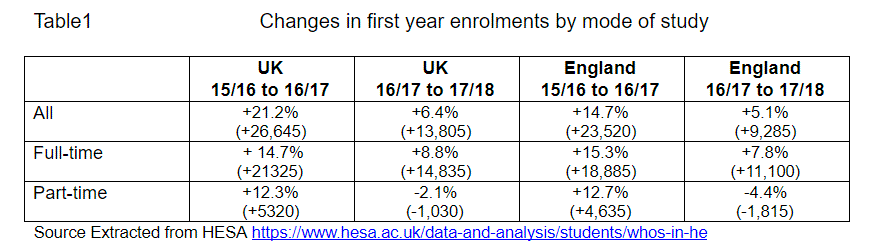
Using the first year ‘All’ UK enrolment figures, master’s participation in 2017/18 increased on the 15/16 figures (when no PG Loan scheme available) by 21.2% (+40,450). When broken down by mode of study, fulltime enrolments have increased the most with 24.6% (+36,160) and part-time by 9.9% (+4,290). When the figures are looked at by country, England, Scotland, Wales and Northern Ireland have all increased their overall first year enrolment figures as well as their full and part-time modes. It is England though where majority of the increase has occurred with +32,805 enrolments comprising +29,985 fulltime enrolments and +2,820 for part-time.
It is very difficult to compare master’s enrolments between England and the other countries comprising the UK because participation figures are significantly smaller than England and funding regimes do differ. However, whilst Scotland, Wales and Northern Ireland have grown year on year in enrolments between 2015/16 and 2017/18, England has not and the part-time mode has in fact declined. But as Table one shows, overall and full-time first year marker figures still remain higher than those in 2015/16. This does appear to demonstrate that the introduction of the PG Loan scheme for master’s participation has had a positive impact on participation.
Who is participating?
What is unclear at the moment from the available data is who is participating. Looking at the characteristics available of the first year enrolment figures participating across all postgraduate taught courses in the UK, the greatest growth continues to be amongst the 21-24 year age group with them representing 47%, an increase in proportion 3.3% on 2013/14 before any PSS or loan intervention was introduced. This reinforces the credential inflation argument due to the massification at undergraduate level.
As expected, the growth for this age group is in fulltime study. Participation in part-time study in the UK between 2016/17 and 2017/18 has declined by 7.2% and across all age groups. This pattern is reflected in the England statistics with a decline of 7.4%. Although much smaller enrolment numbers, part-time enrolments in Scotland, Wales and Northern Ireland have stayed static or increased.
It will be interesting to hear the more detailed analysis by Professor Paul Wakeling at the UKCGE event on 18 March looking at widening Participation at Postgraduate Level.
Although participation figures on the face of it look healthy for master’s degrees albeit smaller growth in 2017/18, the concern raised via some Phase 1 projects including the Postgraduate Experience Project is the PG Loan Scheme alone will not sustain PGT study and it needs to be accompanied by other activities such as extending funding to PG certificates and diplomas enabling continuing professional development staged learning to take place and more flexibility of study modes to be developed.
Comments · 1
New comments will come back with sign-in later this year.
Les Ebdon · 1 Apr 2019
Thank you for this as ever thoughtful analysis. I will be particularly interested when the data emerges to see if the scheme has genuinely widened participation or merely eased the pressure on the ‘ bank of mum and dad’.
Related articles

Whose universities are they anyway?
Jim Dickinson | Analysis | 4/09/26
We say we value diverse research, but can we assess it?
Ola Thomson | Analysis | 27/08/26

Accommodation matters, for foundation year students too
Wendy Ashall | Analysis | 26/08/26

Going deeper: Student loans, public expenditure and the devolution funding gap
Jim Dickinson | Analysis | 25/08/26

Weekend delivery rules won’t be judicially reviewed
David Kernohan | Analysis | 12/08/26

Admission testing needs proper oversight
Beth Hocking | Analysis | 23/07/26