Conversations about academic authorship need to be transparent
Madeleine Pownall and Mary Hausfeld call for research teams to be more explicit, equitable, and reflective about how they assign scholarly credit
Comment|

Madeleine Pownall is an Associate Professor in Psychology at the University of Leeds
Mary Hausfeld is an Assistant Professor in Management at Kemmy Business School, University of Limerick
Authorship carries enormous professional power within academia.
In many disciplines, decisions about who appears first, last, or in middle authorship positions shape hiring opportunities, promotion, funding success, and professional visibility.
For early career researchers especially, authorship can determine access to future academic careers. Despite this, authorship discussions are often informal, delayed, or avoided entirely, which leaves room for misunderstanding, inequity, and conflict.
Speaking out
Current approaches to authorship frequently rely upon individuals speaking out if they believe decisions are unfair.
However, this assumes that all researchers occupy equal positions of power within research teams, which is rarely the case. Hierarchies relating to seniority, gender, race, disability, institutional prestige, contract precarity, and other forms of privilege shape who feels able to challenge decisions and whose contributions are most readily recognised (see the Academic Wheel of Privilege). In this context, expecting junior or marginalised researchers to independently contest authorship decisions places an unfair burden on those with the least institutional power.
The challenge is that most authorship disputes are typically not the result of deliberate misconduct.
More often, they emerge because collaborators simply have different assumptions about what kinds of work should be recognised and when those conversations should take place. One researcher may view conceptualising the project as the defining contribution, another may place greater value on data collection or manuscript drafting, while yet another assumes that project management or supervision should carry significant weight.
Unless these expectations are made explicit, collaborators can work on the same project while holding fundamentally different ideas about how credit will ultimately be allocated.
Tracing a solution
This issue is becoming more pressing as research itself changes. Collaborative, interdisciplinary, international or “big team science” projects are increasingly the norm, involving larger teams and more diverse forms of expertise. Alongside traditional scholarly activities sit forms of labour that often receive less recognition, including project management, stakeholder engagement, mentoring, administrative coordination and community partnership.
Existing authorship guidelines help define who qualifies for authorship, but they do little to facilitate the conversations that teams need in order to reach shared expectations.
There could be a simple way to fix this. For example, a “tool” that we are loosely terming TRACE: Transparent Review of Authorship Contribution Expectations could be a place to start.
TRACE is, in theory, an easy-to-implement, scalable, and customisable tool designed to facilitate earlier, more transparent, more reflective, and ideally more equitable conversations about authorship within academic research teams.
TRACE asks collaborators to independently and anonymously reflect on anticipated contributions, expectations around authorship order, and areas of labour they believe risk being overlooked.
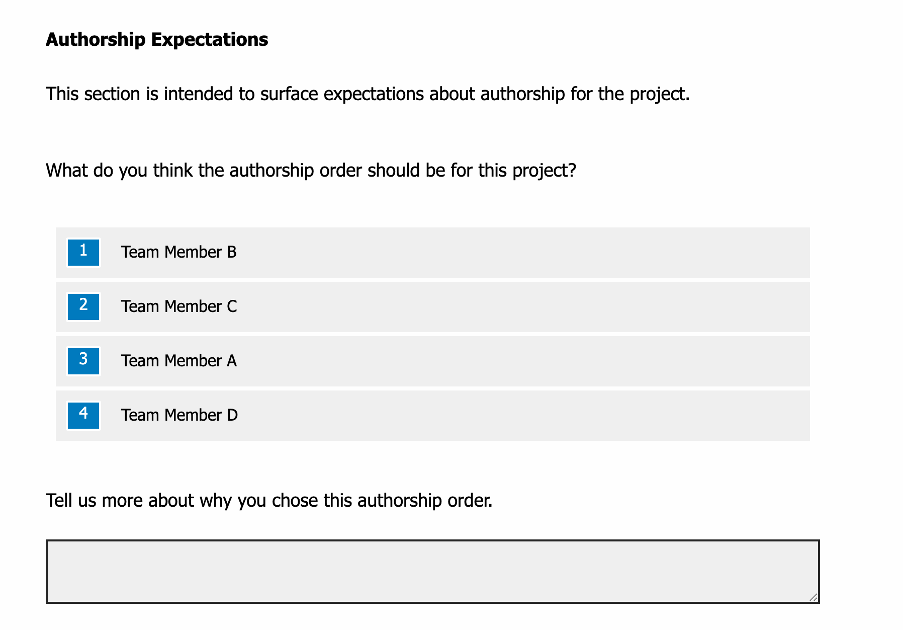
Rather than producing an algorithm for determining authorship, the process is designed to reveal where expectations are mismatched so that discussions can happen early, before disagreements become conflicts. Therefore, instead of relying on spontaneous conversations about authorship, which can often be uncomfortable, or retrospective conflict resolution, the TRACE process provides collaborators with a structured opportunity to independently reflect on contributions, expectations, and authorship. This allows teams to surface misperceptions of authorship order expectations in a transparent way.
We have developed two versions of the tool, one intended for early conversations as projects are just beginning, the other for later conversations, such as just before submitting to a journal, which are available as Qualtrics templates here.
This approach may also help address longstanding inequities in academic recognition. Research consistently demonstrates that women and marginalised scholars are more likely to have their labour overlooked, minimised, or attributed to senior colleagues. Transparent systems of expectation-sharing can encourage accountability and create opportunities to examine whether recognition aligns fairly with contribution.
Given the immense power attached to authorship within academia, we argue that research teams should adopt more explicit, equitable, and reflective approaches to determining scholarly credit. TRACE is one place to start.
Related articles

Student transition into university shouldn’t be a handover
Katharina De Vita | Comment | 13/10/26

Creating a space and a voice for widening participation professional practice
Tara Webster-Deakin | Comment | 13/10/26

During times of transformation emerging leaders need to be inside the leadership tent
Alistair Jarvis | Comment | 12/10/26