Britain likes its universities but not its degrees
Polling suggests the public still values universities but no longer trusts the deal they offer. Jim Dickinson sifts five years of surveys for what’s driving the doubt – and what universities can do about it
Comment|

Jim is an Associate Editor (SUs) at Wonkhe
Barely a day goes by without a poll, a think tank or a columnist declaring that a degree is no longer worth it.
Graduates post screenshots of student loan balances that never seem to go down, ministers spend every August reminding school leavers that there are other options, and the phrase “Mickey Mouse degrees” never quite dies.
And yet most parents still want their children to go, and universities remain a source of local and national pride.
So what does the public actually think – and if higher education is so demonstrably valuable, why is it so relentlessly questioned?
We have plenty of polling on what the public thinks about universities, and very little rigorous research on why opinion moves.
Most of the explanations on offer – including some of ours – rest on what respondents say about their own reasons, plus a fair bit of interpretation.
So what I’ve done here is set out what the polling shows, where opinion seems to be heading, and what universities can and can’t do about it.
What we’re measuring
The UK has nothing like Gallup’s long-running American question on confidence in higher education. There’s a patchwork instead. The British Social Attitudes survey has asked about the value of a degree since 2005, Public First (now PF Global) has run sector-commissioned surveys since 2021, and More in Common, YouGov and Ipsos have added one-offs.
The wordings differ, samples shift between England and the UK as a whole, and some of the most quoted work was paid for by organisations with an obvious interest in the answers. That doesn’t make the numbers wrong, but it’s not easy to whittle up a single trend line.
Other countries go further. New Zealand has turned public acceptance into a standing measurement function, with Education New Zealand running an annual survey it explicitly calls its “social licence” research.
Opinion data also measures perception rather than damage. In Australia, seven years of data showed no significant link between international student numbers and rents in any capital city after the pandemic, yet students got the blame anyway – partly, the researchers suggest, because they don’t vote.
A measure of public acceptance can register a grievance out of proportion to the evidence, and miss documented harms to people outside the population being polled.
There’s a wider problem too – the sector’s evidence about itself tends to be aggregate, self-commissioned and invisible, while the stories that shape opinion tend to be specific, independent and vivid.
Institution versus degree
A useful way to look at the UK data is to differentiate between what people think of universities and what they think of a degree.
Goodwill towards the former largely holds. The UCL Policy Lab and More in Common report Shared institutions found 63 per cent saying universities have a positive impact against 6 per cent negative, and around three quarters of the public consistently say universities matter for research and innovation.
The degree is a different issue. The British Social Attitudes survey found the share saying a degree isn’t worth the time and money rose from 14 per cent in 2005 to 34 per cent in 2025, and 77 per cent now say a degree isn’t good value at current prices, up from 51 per cent in 2014.
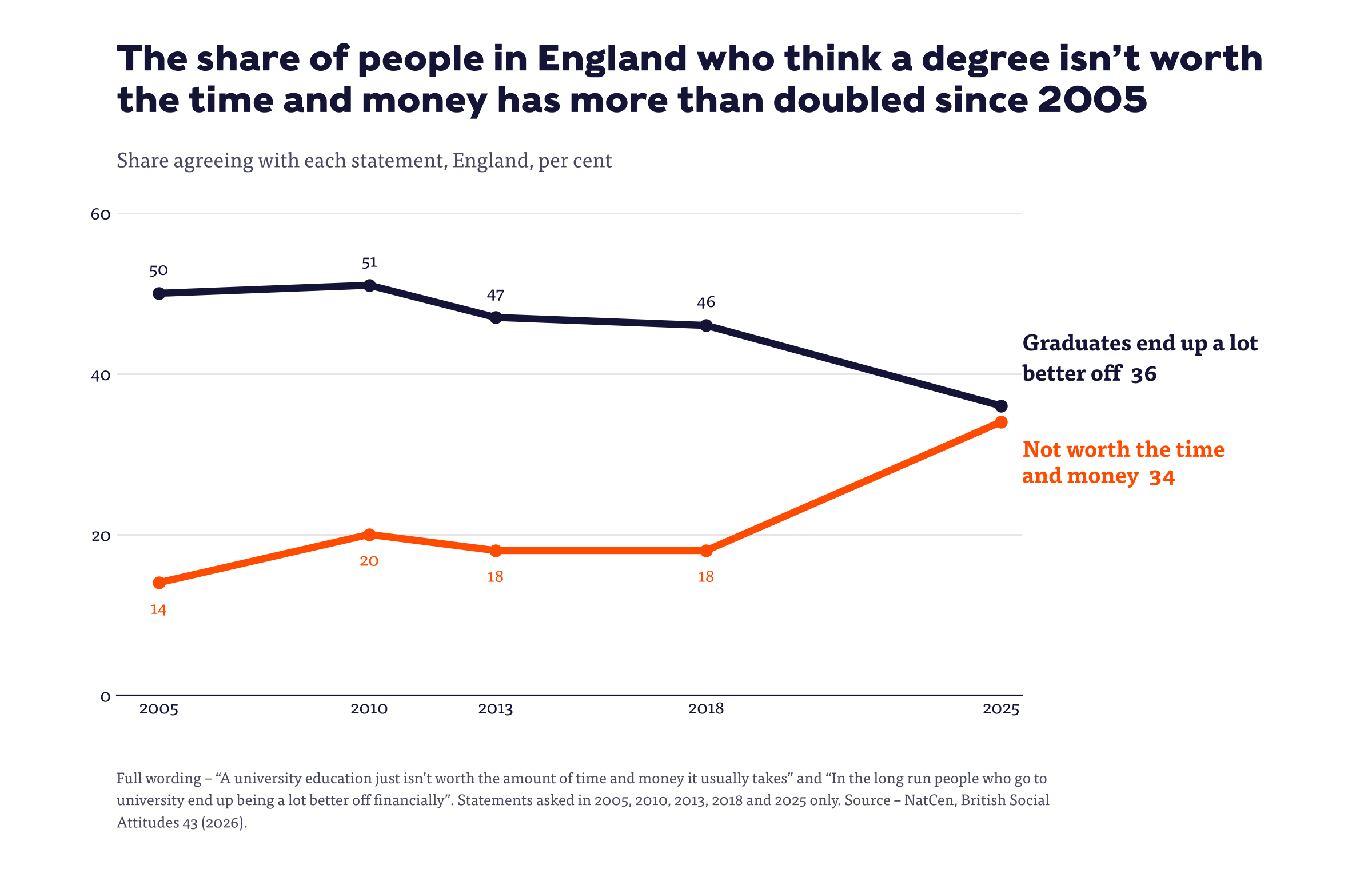
As our own David Kernohan noted at the time, the share wanting fewer opportunities to go to university hit a historic high of 18 per cent, while those wanting more fell from 44 to 37 per cent.
Britain also looks bad against other countries. In the 2026 Ipsos Education Monitor, 28 per cent of Britons said degrees merit the cost, against an average of 53 per cent across 31 countries. Britain came bottom on whether a degree is very important to succeed, and was one of only two countries where the preferred advice to a young person was to go straight into work.
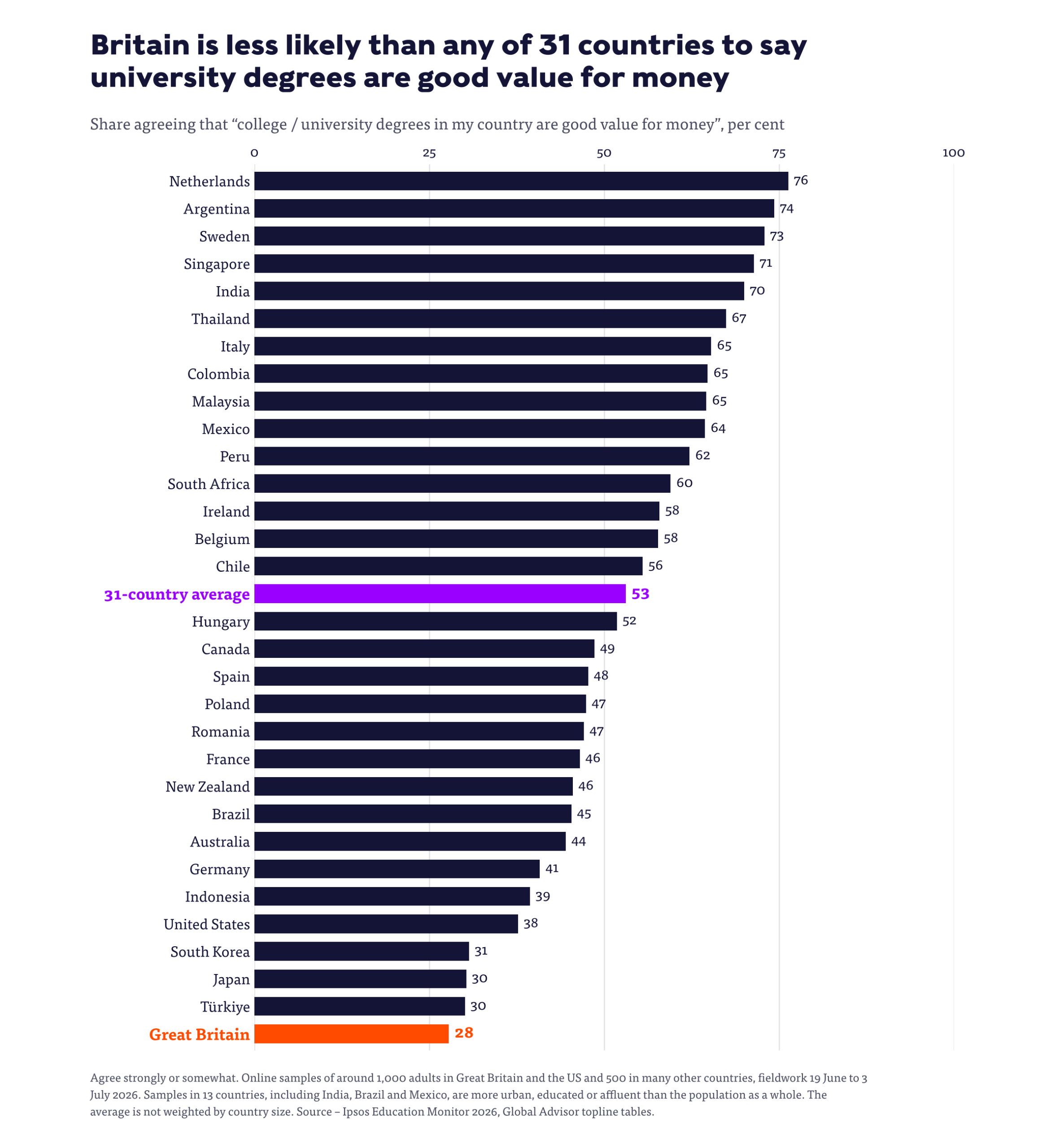
That scepticism cuts across parties. Around a third of Conservative, Labour and Green supporters alike say university isn’t worth the investment, so if you’re tempted to treat “low-value degrees” as a right-wing talking point I’d gently suggest you’re misreading the data.
Five years of polling
Public First’s polling is the closest thing we have to a series, and it describes a drift. The first UPP Foundation and HEPI survey in 2021, modelled on Pew’s American work, found four times as many people positive about universities as negative – but almost half were neutral.
Leave voters and Conservatives were less positive, but where American Republicans had turned hostile, British sceptics were mostly indifferent – as we said back then, the default stance was a shrug.
Three findings from that first wave have recurred ever since. Those with least contact with a university were the most negative, and a third of people had never visited one, rising to over half in the DE social group. People were far warmer about university for their own children than about participation in general.
And majorities agreed both that studying something without a clear professional link is a waste of time and that enjoying a subject is reason enough to study it.
By the 2023 wave overall support was stable, but the most negative segment had become more extreme. Work for the APPG for Universities in 2024 found the sector’s financial crisis hadn’t registered – only 32 per cent thought universities had too little money, and more people wanted universities to recruit more international students or make savings than wanted more taxpayer funding or a higher fee cap.
In late 2025, Degrees of doubt took focus groups to Reform UK voters in university towns and found them unconvinced of a degree’s value and of the sector’s local economic benefits, even where the university was a major employer.
And Public First’s student loans polling in March 2026 found 65 per cent rating the total debt burden unfair, with the public split, as I argued at the time, between those who see the system as a loan and those who see it as a tax.
Over time the series shows opinion moving from broad neutrality toward conditional support, with a hostile minority hardening at the edge.
What the public judges
On our Making sense of higher education – public value and public perception module, PF Global’s Annie Bell had a simple explanation for all of that.
However you poll or run a focus group, the public ends up judging universities almost entirely through the career value to individual home students – ask about research, civic activity or global reputation, and people just bring it back to whether going leads to a decent job.
They also judge it personally. In focus groups, culture war stories and vice chancellor pay barely get a mention, and what people reach for first is someone they know – a neighbour’s niece who went to university and couldn’t find work. If, as the IFS estimates, around a quarter of graduates don’t see a financial return, most people will know one.
Her explanation for why the wider value of higher education has stopped registering is all about money. UUK and London Economics reckon graduates now cover 84 per cent of the cost of a degree, up from 52 per cent in 2012–13. If the individual pays for almost everything, and the case for asking them to was higher earnings, it’s no wonder earnings became the measure.
She also notes that people often aren’t blaming universities themselves. They’re worried that too many young people are being nudged onto a route that won’t pay off, which is a verdict on the system, and now one of the Prime Minister’s most oft-used (and repeated by loyal MPs) “lines”.
Who the sceptics are
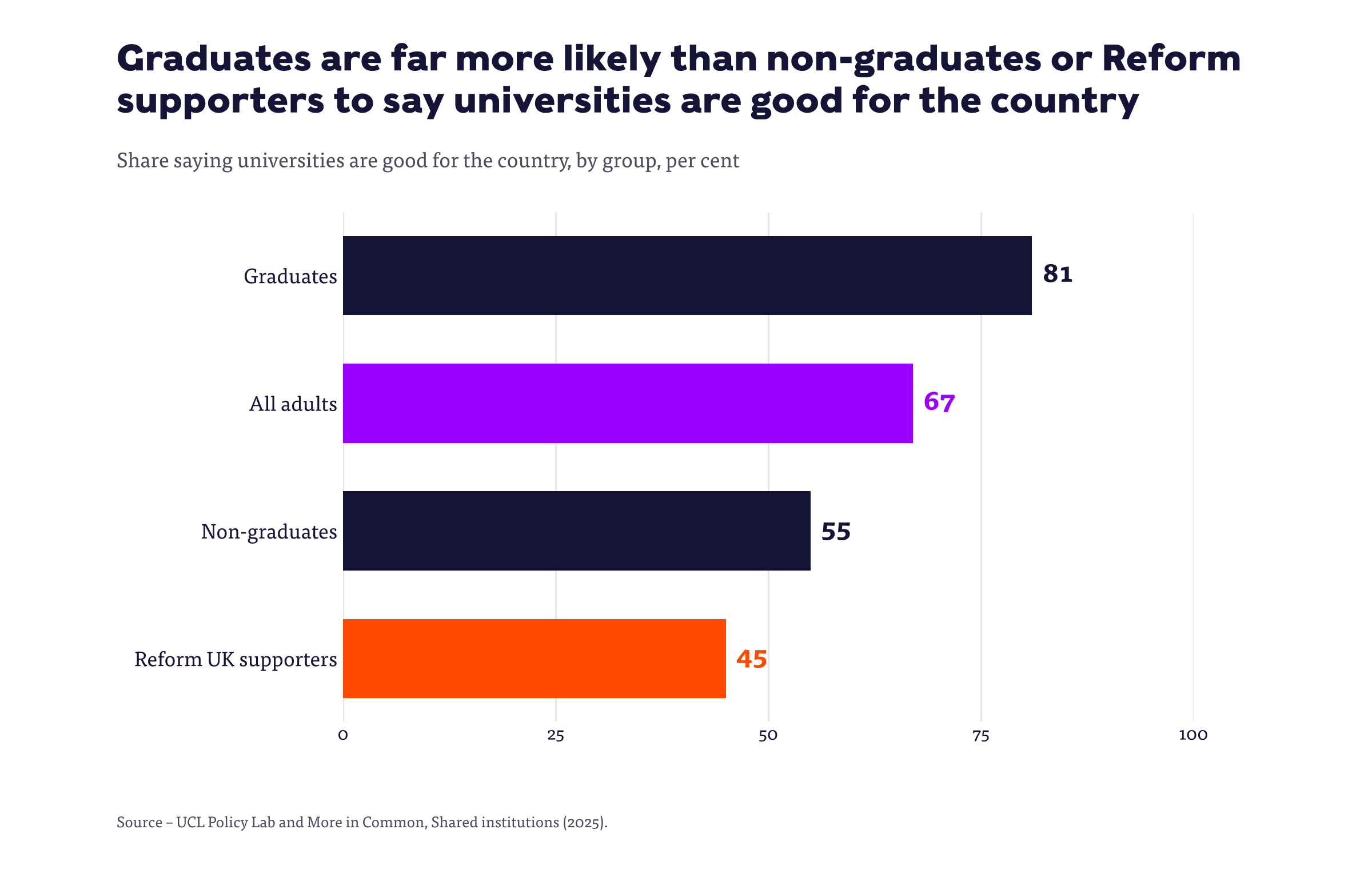
Doubt about the degree may be cross-party, but views of the institution split – first along education, then along party. Shared institutions found 81 per cent of graduates saying universities are good for the country, against 55 per cent of non-graduates, and almost half of non-graduates saying universities look after the interests of the rich and powerful.
Only 45 per cent of Reform supporters thought universities good for the country, against 67 per cent of the wider public, and UCL’s Steve O’Neil has charted how the political centre of gravity has been shifting towards those sceptics.
Graduates aren’t reliable allies either. Polling finds 63 per cent backing dropping the target for half of young people to go to university, with majorities in every voter group and support rising to 75 per cent among graduates.
Yet people overwhelmingly want their own children and grandchildren to go, including 70 per cent of 2024 Reform voters. Basically, those most proud of their own degrees are the most likely to want to restrict everyone else’s.
The American warning
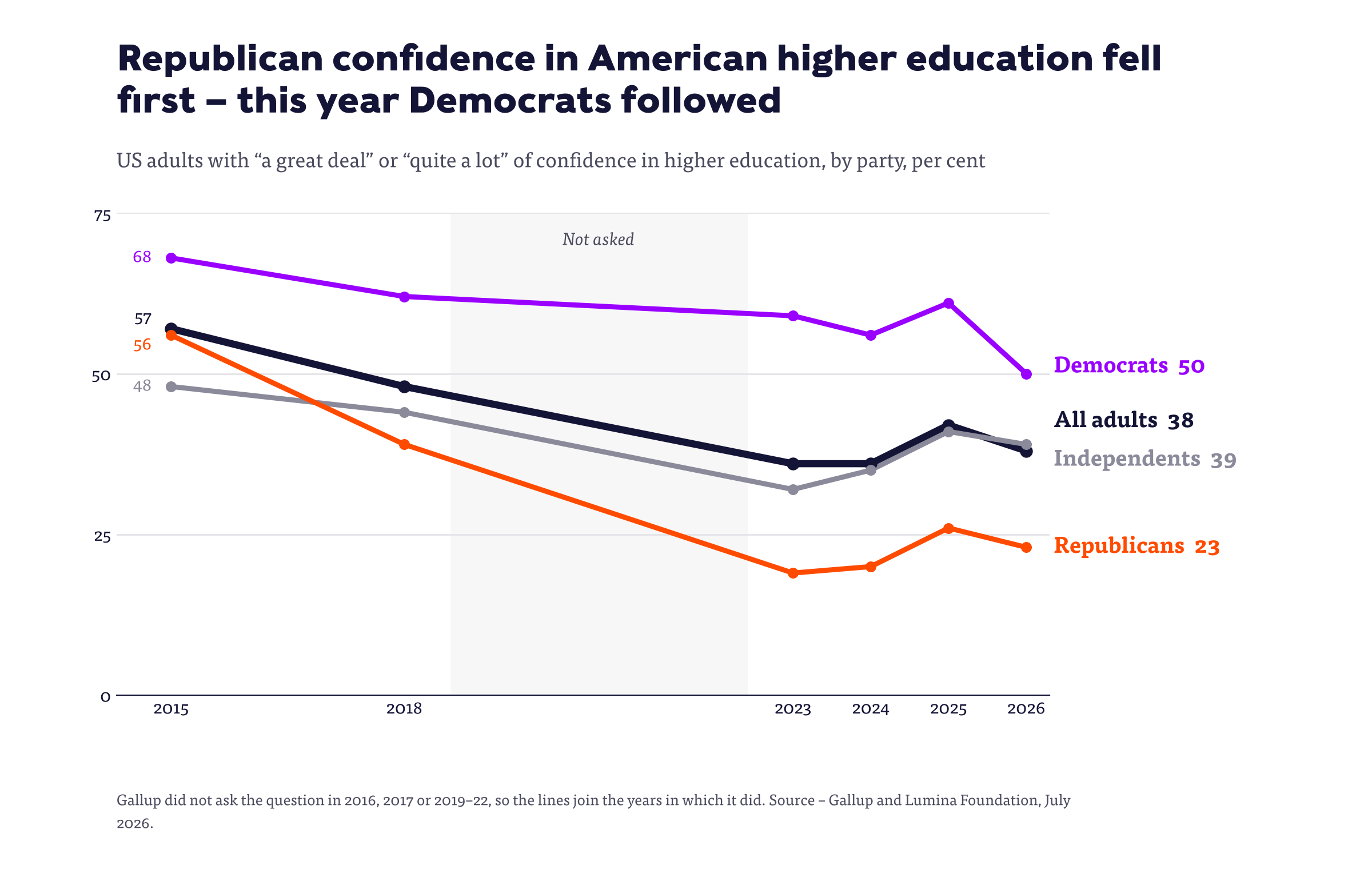
The US is a good place to look for where this might end up. When Gallup first asked about confidence in higher education in 2015, 57 per cent of Americans had “a great deal” or “quite a lot”. By this summer it was 38 per cent, after a brief recovery in 2025.
The long-run fall is steepest among Republicans, but this year’s drop came almost entirely from Democrats, down from 61 to 50 per cent after a year of very public conflict between universities and the Trump administration. Americans with only a bachelor’s degree are now about as sceptical as those with none.
Among the unconvinced, the reasons cluster around perceived political agendas, cost and failure to prepare students for work. Research is the exception – it’s the one area where a majority still rates higher education well.
One account of the partisan collapse is Matt Grossmann and David Hopkins’ Polarized by degrees, which argues that American politics has realigned around education itself. There, universities became one of the realignment’s most visible symbols without having caused it.
But there’s evidence that institutions made things worse. In a preregistered experiment, Floyd Jiuyun Zhang found that Nature’s 2020 endorsement of Joe Biden reduced Trump supporters’ trust in the journal while barely moving anyone’s view of the candidates.
And in April, Yale’s Committee on Trust in Higher Education identified “soaring” tuition fees, opaque admissions and cultures of ideological conformity as drivers of decline, with its president accepting that Yale must take responsibility for its part.
The UK picture is different. In the US both the institution and the degree have lost standing, and the loss is heavily partisan.
Here the institution keeps its goodwill while faith in the degree has fallen across parties – More in Common’s Luke Tryl has described the British public’s concerns as mostly about the value of a degree. The risk is that Reform-leaning non-graduates fuse value scepticism with institutional hostility, as Republicans did after 2015.
Trow saw it coming
None of this would have surprised Martin Trow. His 1973 framework divided systems into elite – up to 15 per cent participation – mass, at 15 to 50 per cent, and universal, above 50 per cent. In an elite system higher education is a privilege, in a mass system it becomes a right, and in a universal system it becomes an obligation, with not going treated as a weakness.
The participation thresholds are the bit everyone remembers, but his framework ran across eleven dimensions, as the table below – paraphrased from the 1973 paper and his 2006 reflections – sets out.
| Dimension | Elite | Mass | Universal |
|---|---|---|---|
| Size of system (participation rate) | Up to 15 per cent | 16–50 per cent | Over 50 per cent |
| Attitudes to access | A privilege of birth, talent or both | A right for those with certain qualifications | An obligation for the middle and upper middle classes |
| Functions of HE | Shaping the mind and character of a ruling class, preparing for elite roles | Transmitting skills, preparing for a broader range of technical and economic elite roles | Adapting the “whole population” to rapid social and technological change |
| Curriculum and instruction | Highly structured around academic or professional conceptions of knowledge | Modular, flexible, semi-structured sequences of courses | Boundaries and sequences break down, as does the distinction between learning and life |
| The student “career” | Sponsored straight from school, uninterrupted study to degree | More delay entry, more drop out | Much postponed entry, blurred lines between study, work and the rest of life |
| Institutional characteristics | Homogeneous, high common standards, small residential communities, clear boundaries | Comprehensive, more diverse standards, “cities of intellect”, mixed residential and commuting, fuzzy boundaries | Great diversity with no common standards, aggregates of enrolled people, some rarely or never on campus, boundaries weak or absent |
| Locus of power | “The Athenaeum” – a small elite with shared values | Ordinary interest-group and party politics | “Mass publics” questioning academe’s privileges and immunities |
| Academic standards | Broadly shared and relatively high | Variable – institutions become “holding companies” for different kinds of enterprise | Shift from “standards” to “value added” |
| Access and selection | Meritocratic, based on school performance | Meritocratic plus compensatory programmes for equality of opportunity | Open, with emphasis on equality of group achievement (class, ethnicity) |
| Academic administration | Part-time academic “amateurs”, elected or appointed for limited terms | Former academics as full-time administrators, plus a growing bureaucracy | Specialist full-time professionals, management techniques imported from outside academe |
| Internal governance | Senior professors | Professors and junior staff, with growing student influence | Breakdown of consensus – decisions drift towards political authority |
People who feel they had to go, or had to send their children, judge institutions on price and payoff more than mission. That may explain an apparent oddity in the Ipsos data – a public that still overwhelmingly wants its own children to go is also one of only two out of 31 countries where the preferred advice to a young person is to go straight into work. An obligation can be resented and observed at the same time.
Trow also argued that expansion ends universities’ insulation and turns their internal affairs into ordinary political business.
In his 1996 paper “Trust, markets and accountability in higher education” he argued that where trust erodes, accountability regimes replace it. The UK made that swap much earlier than the US, which may explain why backlash here shows up through regulators, fee settlements and free speech legislation, while the US has a funding war waged on individual institutions.
Where Trow is less help is on the form the backlash took. He predicted more political attention, but not one party building a coalition around non-graduates and treating universities as the opposition.
What universities control
Some of this is beyond the sector’s reach. The diploma divide is portable – it’s visible in the Brexit vote and in Reform’s coalition – and universities risk becoming a tribal marker whatever they do. The graduate labour market, regional economies and the design of student finance are largely matters for government.
“Telling our story better” has been the sector’s answer for over a decade, and it hasn’t worked. The alternative is a relentless focus on outcomes, so that when the neighbour’s niece can’t find work, the story ends with the university having done everything it could to help.
Universities UK president Malcolm Press has started talking about a “social licence” – a term borrowed from mining, already doing the rounds in Australia, as Michael Salmon has noted, and one New Zealand now measures every year. An impact report says universities deserve support because of what they produce. A licence says they have to remain worth tolerating, sustained through conduct, continuously – which invites a question about who’s doing the tolerating.
As Debbie McVitty noted after UUK’s conference, that question has different answers depending on the size of the community. Nationally the argument is about migration, graduate returns and campus politics, while locally it’s a function of relationships of trust.
The evidence also points to a few things universities can do. Contact changes minds, which makes opening campuses up a reputational strategy as well as a civic one. Framing matters – in one More in Common experiment, tying a fee rise to quality and outcomes cut opposition from 49 to 37 per cent. Institutions rooted in their places fare better than the sector brand.
And the capacity to complain doesn’t follow the harm. Studentification research has found organised residents in Headingley getting universities to the table, while a deprived estate in Brighton absorbed similar costs with far less ability to mobilise.
Then there are the smaller choices. Over-recruiting beyond what a city’s housing can take, publishing cost of living estimates that understate the real cost, or not chasing up compulsory harassment training in case it puts applicants off are all decisions made in meetings, for understandable reasons, every day.
None of them makes headlines on their own. Collectively, they shape the experiences people later describe to a focus group.
The critical unknown
The biggest open question is whether any of this changes behaviour. What people do may matter more than what they say, and UCAS demand has held up. The counterpoint is that demand may reflect a lack of alternatives at scale.
There aren’t enough apprenticeships for everyone who wants one, and a sector whose applicants go to university because they couldn’t get an apprenticeship is not in a strong position.
The questioning, in other words, comes from three directions at once – the bill has shifted almost entirely onto the individual, going has become the kind of obligation Trow predicted rather than a choice, and the degree has become a marker of which side of the diploma divide you’re on.
The British public still likes its universities, but it has lost faith in the deal they offer. That makes the problem more economic than cultural for now – both more fixable than the American version, and more dangerous to ignore.


Higher education postcard: Rajabai Clock Tower, University of Mumbai
Hugh Jones | Comment | 9/10/26


Comments
New comments will come back with sign-in later this year.