Devolved-yet-not-independent: TEF and accountability in Scotland
The prospect of Scottish universities participating in TEF presents fundamental questions about the nature of devolved jurisdiction. Vicky Gunn takes a look at ‘devolved-yet-not-independent’ paradox.
This article is more than 9 years old
Analysis|

Vicky Gunn
Professor Vicky Gunn is Head of Learning and Teaching at the Glasgow School of Art and former Director of the Learning and Teaching Centre at the University of Glasgow.
The latest round of DfE consultations on the future, subject-based forms of the TEF are on-going. Open to consulting with various groups, civil servants were dispatched across the devolved borderlands to hear what the nineteen higher education institutions of Scotland might like accommodated into the design.
Though this sounds sensible, it could also be interpreted as a form of enticement designed so the UK government can claim that TEF is being universally implemented across the UK. When the Department for Education (Whitehall) visits Universities Scotland (Edinburgh), it’s hard not to reflect that this is an infringement by Westminster into devolved territory. A visit from the DfE in Scotland about TEF design is, theoretically then, a highly political, quasi-diplomatic event. It is also typical of the increasingly complex situation of devolved-yet-not-independent authority in which the Scottish sector finds itself.
Uncomfortable co-existence
Scottish higher education operates in an environment where very different nations’ policy agendas and frameworks can – indeed must - co-exist in one nation. This is happening even when the legislation behind the policy is geographically limited to one nation, and when the policy that emerges from the two legislatures is contradictory.
This is the case with the TEF. On the one hand, the Scottish government, through the Scottish Funding Council, has a mature and well-respected sector-wide cooperative approach to quality assurance and enhancement: the Quality Enhancement Framework (QEF). This framework has five key components: enhancement-led institutional review, institutional-led subject review, the enhancement themes, public information, and student engagement. Scottish institutions are heavily invested in this structure of accountability, having been involved from the start in QEF’s inception and ongoing management along with NUS Scotland, QAA Scotland, the SFC, Sparqs, and other sector bodies.
The sector is currently being consulted on a refreshing of three of the core components: enhancement-led institutional review, institutional-led subject review, and the enhancement themes. Whilst this consultation is ongoing it is hard not to be distracted by the discussion about design of the TEF. The Scottish sector is very aware that TEF could potentially become an indicator of teaching quality for the whole of the UK, and Scottish institutions do not necessarily want to be exempt from that.
The Scottish government, however, not wishing to intrude has said very little about the TEF because, de jure, it is not relevant to them. Whilst Scottish institutions are welcome to enter the TEF, it is not a formal part of the Scottish government’s own policy agenda.
Clashing methodologies, clashing ideologies
The two distinct teaching accountability mechanisms – QEF and TEF, emanating from Edinburgh and Westminster respectively – represent two very different educational and policy philosophies. They differ in a range of crucial ways, not to mention being dependent on different ‘pipe-lines’ from primary, secondary, and further education.
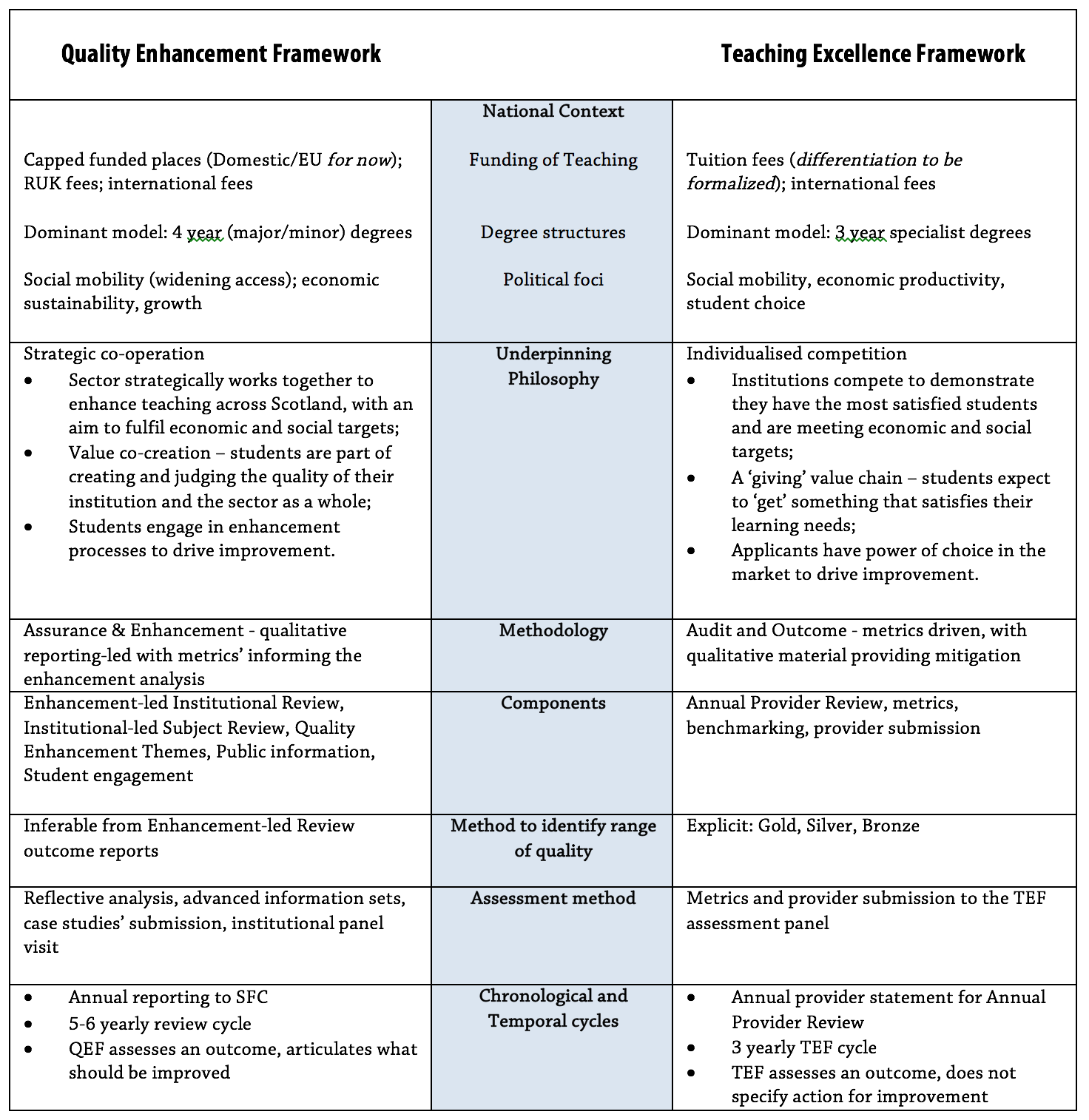
Immigration and data - more challenges ahead?
The introduction of the TEF is demonstrating the limitations of the current devolved-yet-not-independent arrangement between Scottish higher education agencies, institutions, the Scottish government, and their respective bodies south of the border. This is not a problem that is going to go away.
TEF is a particularly egregious example of how the amplified complexity of the devolved-yet-not-independent dynamic can compromise the Scottish sector’s reputation and values. As things stand, there has been hardly any Scottish involvement in the inception and design of the TEF, and the process has been designed for a very different HE teaching accountability policy context. TEF, and its accompanying ideological assumptions, will either inadvertently or deliberately cross the devolved border by stealth, thus undermining the more cooperative philosophy of teaching accountability within the Scottish sector.
The data being used for TEF outcomes does not even align fully with the Scottish government’s own statistical reporting. This was repeatedly shown during the technical consultation for TEF2 earlier this year, particularly when it comes to comparing the Scottish Index of Multiple Deprivation (SIMD) with POLAR. Westminster and Holyrood’s respective approaches to reporting social mobility are not aligned. The Scottish government (and by extension the Scottish higher education sector) has no control over the data used in TEF or the respective algorithms and benchmarks used in TEF outcomes. Arguably, Scottish participation in TEF flies in the face of the spirit of devolution, but where is the debate about the ethics of this jurisdictional nightmare?
Things could well change if TEF is in anyway linked to international student recruitment, which would link a devolved policy matter directly to UK-wide immigration policy. Given the outcome of the EU referendum in Scotland, as well as a spoken commitment to a civic nationalism predicated on the benefits of immigration, this could become an urgent constitutional matter with universities at its heart. We can only await the Home Office consultation to find out.
Comments
New comments will come back with sign-in later this year.
Related articles

Whose universities are they anyway?
Jim Dickinson | Analysis | 4/09/26
We say we value diverse research, but can we assess it?
Ola Thomson | Analysis | 27/08/26

Accommodation matters, for foundation year students too
Wendy Ashall | Analysis | 26/08/26

Going deeper: Student loans, public expenditure and the devolution funding gap
Jim Dickinson | Analysis | 25/08/26

Weekend delivery rules won’t be judicially reviewed
David Kernohan | Analysis | 12/08/26

Admission testing needs proper oversight
Beth Hocking | Analysis | 23/07/26